
Level 1, Level 2, DC Fast: EV Charging Speeds Explained
Last updated: August 24, 2026
Charging equipment advertises itself with a jumble of labels: Level 1, Level 2, 50 kW, 150 kW, 350 kW. On a road trip, those numbers decide whether a stop takes twenty minutes or an entire evening, so they are worth understanding before you plan a route. This guide explains the three charging levels, the difference between kilowatts and kilowatt-hours, why charging slows down as the battery fills, and how all of it maps onto EVLONGHAUL's charger speed filter and charge-time estimates.
Kilowatts and kilowatt-hours, in one minute
The two units look alike and get confused constantly, but the distinction is simple:
- Kilowatt-hours (kWh) measure energy: the size of the tank. Most current EVs carry a battery of roughly 60 to 100 kWh.
- Kilowatts (kW) measure power: how fast energy flows. A 150 kW charger could, in theory, deliver 150 kWh in an hour; real sessions average well below the rated number.
To turn energy into distance, most EVs cover somewhere around 3 to 4 miles per kWh, less at sustained highway speed. A session that adds 50 kWh has therefore added very roughly 150 to 200 miles of driving. Every charging decision on a trip reduces to two questions: how much energy do you need, and how fast can this particular plug deliver it? A third question, what that energy costs, depends on the network and the state: what road-trip charging really costs works through typical per-kWh rates.
Level 1: the wall outlet (skip it on trips)
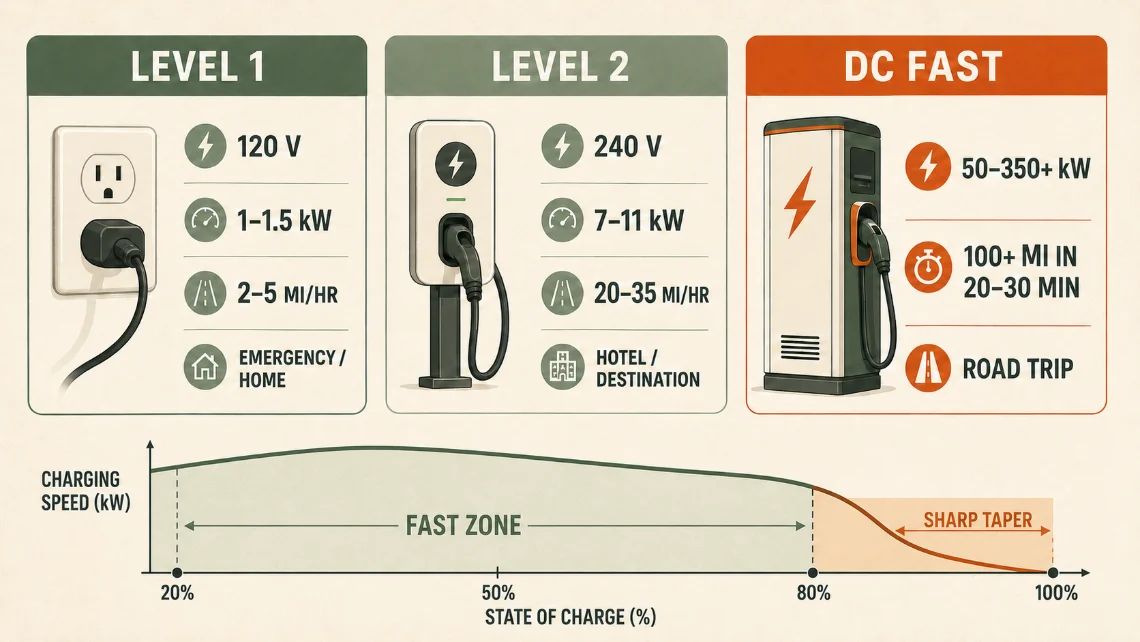
Level 1 is an ordinary 120-volt household outlet, delivering roughly 1 to 1.5 kW through the portable cord that came with your car. That works out to about 2 to 5 miles of range per hour: fine for replenishing a short commute overnight at home, effectively useless on a travel day. If you find yourself overnighting somewhere with nothing but an outdoor outlet, twelve hours of Level 1 might add 30 to 50 miles; treat that as a safety margin, never as the plan. EVLONGHAUL never plans stops at Level 1 outlets.
Level 2: overnight and destination charging
Level 2 runs on 240 volts (the same supply as an electric dryer) and typically delivers 7 to 11 kW, with some public units rated up to about 19 kW. For a typical EV that means roughly 20 to 35 miles of range per hour, so a full charge takes hours, not a lunch break. The U.S. Department of Energy's Alternative Fuels Data Center has a deeper primer on charging equipment if you want the electrical details.
On a road trip, Level 2 is destination charging: the hotel parking lot, the vacation rental, the trailhead you'll be parked at all afternoon. Its job is to hand you a full battery every morning so the day's first fast-charging stop comes later and the day needs fewer of them. Public Level 2 in the U.S. mostly uses the J1772 connector, with NACS appearing on newer equipment. Our CCS vs. NACS guide covers which plugs fit which cars.
EVLONGHAUL's "Level 2 only" filter plans an entire trip around J1772 stations. It suits unhurried travel built on long overnight stops; expect far more stops, each measured in hours.
DC fast charging: the road-trip workhorse
DC fast charging bypasses your car's onboard charger and feeds direct current straight into the battery. Hardware ranges from older 50 kW units through the 150 to 350 kW chargers that now dominate major corridors, and as of mid-2026 several networks are deploying stations rated at 400 kW and above. This is the only kind of charging that fits inside a travel day: in the right conditions, a modern EV can add well over 100 miles of range in 20 to 30 minutes.
The number on the cabinet is a ceiling, not a promise. Your actual speed is the lowest of three limits:
- The charger's rating. A 50 kW unit never exceeds 50 kW, whatever you drive.
- Your car's maximum acceptance rate. A car that peaks at 150 kW gains nothing from a 350 kW cabinet.
- The battery's condition at that moment: its state of charge and temperature, which is where the charging curve comes in.
The charging curve: why cars slow down past 80%
Batteries accept power fastest when they are relatively empty and warm. As the pack fills, the car steadily dials the rate back (the taper) to protect the cells. The exact shape varies by model, but the pattern is universal: peak speed somewhere in the lower half of the pack, a gradual decline through the 60s and 70s, and a sharp drop above roughly 80%.
The practical consequence is that the last 20% of a fast-charging session can take as long as the previous 50%. That is why the road-trip sweet spot is arriving somewhere around 20% and leaving near 80%: you spend your minutes where the charger is actually fast, then drive to the next one. Charging to 100% at a fast charger almost never wins back the time it costs. Cold packs charge slower still. Our winter range guide covers what that does to a January itinerary. EVLONGHAUL's plans follow the same logic: after the first leg, every stop assumes you charge to 80% and move on.
How this maps to the planner
EVLONGHAUL's charger speed filter mirrors the tiers above: any DC fast station (50 kW and up), 150 kW+, 250 kW+, or Level 2 only. A reasonable way to choose:
- 50 kW+ (any DC fast) keeps the most stations in play, which helps on sparse rural stretches and costs little if your car's peak rate is modest anyway.
- 150 kW+ suits most current EVs: meaningfully faster stops without thinning the map too much on major corridors.
- 250 kW+ is worth selecting only if your car can actually accept that much power; otherwise it just shrinks your options.
- Level 2 only is the slow-travel mode described above.
Even on the default setting, the planner prefers stations rated 100 kW or more when it places each stop. Its charge-time estimates are built around the taper, too: each stop adds only the energy the next leg needs, up to 80%, at whichever rate is slower, your car's own average DC charging power or 70% of the station's rated power, because real sessions average far below their peak. The full arithmetic, including the 8% range buffer and how stops get positioned, is in how EVLONGHAUL plans charge stops.
One caveat worth repeating: the planner works from public station data (the U.S. DOE/NREL Alternative Fuels Data Center, with Open Charge Map as a fallback). It knows a station's rated power, not whether the stalls are working or occupied right now. There is no live status here. Before you rely on any single stop, verify it in the charging network's own app, and keep a second option in mind.