CCS vs NACS in 2026: Which Plug Does Your Road Trip Need?
Last updated: July 23, 2026
American fast charging is midway through a plug swap. The Tesla-derived NACS connector, standardized as SAE J3400, is becoming the default port on new EVs, while the CCS1 connector still dominates the installed base of cars on the road. Mid-2026 is the messy middle: which plug your car carries decides which stations you can use without an adapter, and that in turn shapes every charging stop on a long trip.
Here is where things stand, and how to make sure your trip plan reflects your actual hardware.
Where the transition stands in mid-2026
Nearly every automaker selling EVs in North America has committed to NACS, but the rollout is happening brand by brand and model by model. Broadly, three groups of cars are on the road right now:
- Native NACS cars. Teslas, plus a growing set of 2025–2026 models from other brands that ship with a NACS port from the factory.
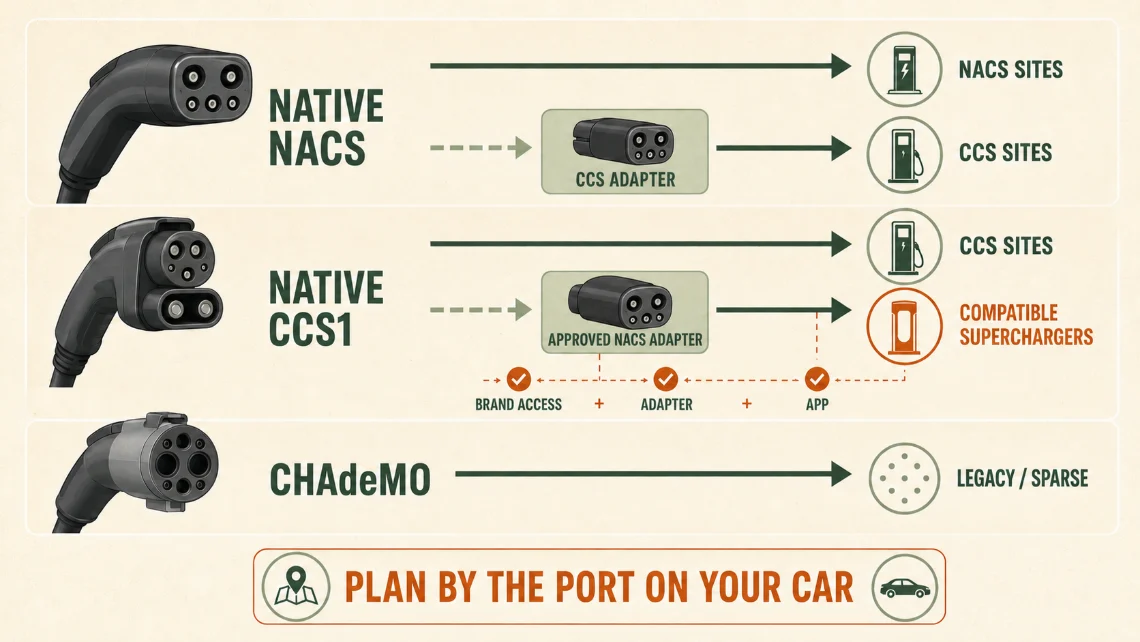
- CCS1 cars. Most non-Tesla EVs built from roughly 2018 through 2025, and a fair number of 2026 models still working through the changeover. These fast-charge natively at CCS stations and can reach many Tesla Superchargers with an adapter.
- CHAdeMO cars. Mostly the pre-2026 Nissan Leaf, on a legacy connector that is fading.
Meanwhile the station side is converging from both directions: Tesla has opened tens of thousands of Supercharger stalls to non-Tesla cars, and CCS networks such as Electrify America, EVgo, and ChargePoint have been adding NACS cables to new and existing dispensers.
Which cars ship with a native NACS port
As of mid-2026, vehicles shipping with NACS built in include the entire Tesla lineup, the Hyundai Ioniq 5, Ioniq 6, and Ioniq 9, the Kia EV6, the 2026 Rivian R1T and R1S, the 2026 Cadillac Optiq, and the redesigned 2026 Nissan Leaf, with more arriving from Ford, GM, Toyota, Honda, and others throughout the year. Adoption timing varies even within a brand, so a 2026 model from a committed automaker may still carry CCS1.
The only reliable answer is the port on your specific car. Check the charge door before you plan around it, and note that some new NACS cars, like the 2026 Leaf, pair the NACS DC port with a separate J1772 port for AC charging.
Using Tesla Superchargers in a CCS car
Most CCS-port EVs can now fast-charge at Tesla Superchargers, but three things have to line up:
- Your automaker's agreement. Supercharger access is granted per brand, not per adapter. Nearly every major automaker is enrolled by mid-2026, but confirm yours is live before counting on it.
- An approved NACS-to-CCS adapter. Use the adapter your automaker supplies or endorses (many were shipped free to owners; others sell for very roughly $200). Cheap uncertified adapters carry hundreds of amps between your battery and the grid. This is a poor place to save money.
- App setup. Typically you create a Tesla app account, add your vehicle and a payment method, pick the site and stall number, and start the session from the phone; some automakers integrate Supercharging into their own apps, and many newer V4 sites include contactless card readers or payment kiosks.
Only newer Supercharger hardware (generally V3 and V4 stalls) is open to non-Tesla cars; older V2 sites are Tesla-only. A small share of sites also offer Magic Dock, a built-in CCS adapter, but as of mid-2026 there are only a couple thousand of those stalls nationwide, spread unevenly across the country, so carry your own adapter rather than hunting for one. One practical wrinkle: Supercharger cables were designed for Tesla's rear-driver-side port, so cars with ports elsewhere sometimes have to park across two stalls. Newer V4 sites have longer cables that ease this.
Reaching CCS stations in a NACS car
The reverse direction is simpler. A native NACS car uses a CCS1-to-NACS adapter (Tesla sells one, and most automakers include or offer one with new NACS vehicles) to charge at any CCS fast charger. Since CCS still represents the bulk of non-Tesla DC fast charging hardware, that adapter belongs in your trunk on any long trip; our road-trip checklist treats it as standard equipment. Increasingly you will not need it at all, as major CCS networks add native NACS cables, but coverage is uneven enough in mid-2026 that you should not assume a NACS cable at any given CCS site.
Getting the right adapter
At Tesla Superchargers, only adapters provided by Tesla or your vehicle's manufacturer are permitted. Third-party adapters are prohibited (Tesla's Supercharging policy). Get yours from your automaker:
- Free or complimentary from the automaker: Ford, Rivian (included with new vehicles), Hyundai, Genesis, Toyota (bZ4X), and Lexus have shipped no-cost adapters. Claim through the automaker's owner portal or your dealer.
- Sold by the automaker or dealer: GM (Chevrolet/GMC/Cadillac), Volkswagen ($200, with a $100 rebate for 2025-model owners), Mercedes-Benz ($185 through dealers), and Subaru (pre-2026 models).
- BMW directs owners to a specific approved adapter. Confirm the current recommendation with your dealer.
- Jaguar (I-Pace) does not offer an adapter, so Supercharger use isn't supported.
- Most 2025-and-newer NACS-native vehicles plug straight in: no adapter needed at Superchargers.
Tesla drivers using CCS stations: Tesla's official CCS1 to NACS Adapter (~$200) is the manufacturer-approved route. Your car must show "CCS adapter support: Enabled" under Software. Other NACS-native vehicles: use your automaker's approved CCS adapter (often included with the car).
Aftermarket adapters such as the Lectron Vortex Plus (~$185) and A2Z Typhoon Pro (~$170) carry UL 2252 safety certification and work at other networks' NACS cables (ChargePoint, IONNA, and EVgo are adding them), but they are not permitted at Tesla Superchargers, and you should confirm your automaker's warranty position before relying on one.
Where CHAdeMO stands
CHAdeMO is effectively a legacy connector in the U.S., kept relevant by the large population of 2011–2025 Nissan Leafs still on the road. Few new CHAdeMO dispensers are being installed, and some networks have begun retiring old ones, though many multi-standard stations still carry a CHAdeMO cable alongside CCS. If you drive a CHAdeMO Leaf, long trips take more care: plan around the stations that actually have your plug, expect them to be sparser than CCS, and verify each one is operational before you rely on it. The 2026 Leaf's switch to NACS ends the line, but existing cars will depend on this shrinking network for years.
What this means in the EVLONGHAUL planner
EVLONGHAUL filters stations by connector, so the plug you pick changes the entire itinerary: which stops appear, how far apart they sit, and which of up to three alternate routes wins. The planner draws public DC fast-charging stations within about five miles of your route from the U.S. DOE/NREL Alternative Fuels Data Center, keeps only those listed with a match for your selected connector (CCS, NACS, CHAdeMO, or J1772 for Level 2 trips) and places each stop at a real station near the point where your energy budget runs out. The full method is described in how we plan charge stops.
Two practical tips follow from the transition:
- Plan by port first. Pick the connector that matches your car's native port. If you carry an approved adapter and your brand has Supercharger access, running a second plan with the other connector shows you what the adapter unlocks: often a meaningfully different route. The difference is largest where Superchargers are thick on the ground, such as the I-95 corridor.
- Mind the speed filter. Station hardware varies from 50 kW to 350 kW regardless of plug shape; the 150 kW+ and 250 kW+ filters help match stops to what your car can actually use. See charging levels explained for how those numbers translate to time at the plug.
Remember that EVLONGHAUL works from public station data and produces estimates. It does not know whether a stall is occupied, offline, or newly fitted with a NACS cable, so verify your critical stops in the station's own app before you drive.