
What Road-Trip Charging Really Costs
Last updated: July 23, 2026
Fuel cost is usually the second question people ask about EV road trips, right after range. The honest answer, as of mid-2026: highway DC fast charging often costs about the same per mile as gasoline in a reasonably efficient gas car. The savings come from everywhere else you charge: your garage, your hotel, any cheap Level 2 plug the night before. This guide walks through current pricing, the fees that catch people off guard, and worked math for a real leg so you can budget a trip without surprises.
What DC fast charging costs per kWh
Most large U.S. networks now bill by the kilowatt-hour, the way a gas pump bills by the gallon. As of mid-2026, guest rates at the major networks typically land between about $0.40 and $0.60 per kWh, with $0.45 to $0.55 common. Rates vary by network, by state, sometimes by individual site, and increasingly by time of day, so treat any single number as a snapshot rather than a promise. Always check the price on the charger screen or in the network's app before you plug in.
For scale: a typical road-trip stop adds 40 to 50 kWh, so expect roughly $18 to $28 per stop at guest rates. That is well above home electricity (around $0.18 per kWh on average for U.S. residential service) because a fast-charging site carries hardware, maintenance, and commercial demand charges that your garage outlet does not.
Per-minute pricing, session fees, and idle fees
- Per-minute billing. Some states long restricted per-kWh electricity sales to regulated utilities, so stations there billed by the minute instead. Most states have since cleared the way for per-kWh pricing, but per-minute billing survives at some stations. It favors cars that sustain high charging speeds: a slow-charging car pays more for every kWh it actually receives. If you see a per-minute rate, arriving with a low battery and stopping at 80% keeps you in the fast part of the charging curve.
- Session fees. Flat per-session fees have mostly disappeared at the biggest networks, but some networks and pay-as-you-go plans still add one, often around a dollar. Memberships usually waive it.
- Idle fees. Once your car finishes charging, you typically get a grace period of about five to ten minutes, then a per-minute fee until you unplug and move: commonly around $0.40 per minute, and as much as $1.00 on some networks when the site is full. Turn on your charging app's notifications and head back to the car when the session nears its target.
Memberships that cut the rate
If your route leans on one network, a monthly membership usually pays for itself on a single long trip. As of mid-2026, the common patterns look like this:
- Electrify America Pass+ runs about $7 per month and takes roughly 25% off the per-kWh (or per-minute) price.
- EVgo Plus and similar plans run about $7 per month for discounted rates and waived session fees, with steeper discounts on higher tiers.
- Tesla Supercharger membership for non-Tesla drivers costs about $12.99 per month and drops you to roughly the rates Tesla owners pay. Without it, non-Tesla cars typically pay a premium on the order of 30–40%, often $0.10 or more per kWh. You'll need a native NACS port or an adapter. See CCS vs. NACS for where the transition stands.
The math is simple: 25% off a 45 kWh session at $0.52 per kWh saves about $6, so one or two road-trip stops cover the fee. Most plans are month-to-month, so you can sign up the night before a trip and cancel afterward. Prices change often; verify current rates in each network's own app, because EVLONGHAUL plans stops from station location and hardware data and does not track pricing.
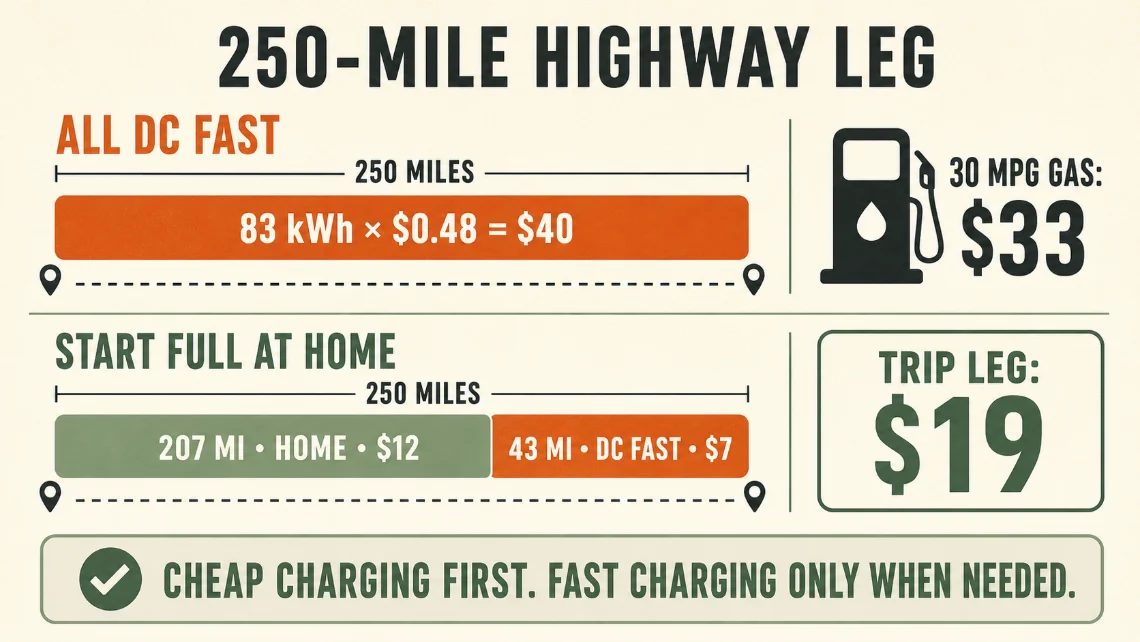
The honest math: a 250-mile leg
Take a 250-mile highway leg in an EV that averages 3 miles per kWh at Interstate speed, a realistic figure for a midsize electric crossover. The leg needs about 83 kWh.
- All DC fast charging at a typical $0.48 per kWh: about $40. Across the $0.40–$0.60 range, that's $33 to $50.
- The same leg in a 30 mpg gas car at the mid-July 2026 national average of roughly $4 per gallon: about 8.3 gallons, or $33.
So a fast-charged mile costs about the same as a gas mile, and sometimes more. If that's disappointing, notice the assumption doing the work: nobody fast-charges an entire leg if they can help it.
Now run it the way a real trip works, starting with a full battery from home. For a car with 250 miles of EPA range, EVLONGHAUL budgets 230 usable miles (an 8% buffer for highway speeds and weather). Leaving at 100% with a 10% arrival reserve gives you about 207 miles before the first stop, and those miles were bought at home rates, roughly 69 kWh at $0.18, or about $12. Fast-charging the remaining 14 kWh or so adds about $7. Leg total: around $19, a bit more than half the gas cost. How EVLONGHAUL plans charge stops explains this leg-budget math in detail.
Efficiency swings the numbers both ways. A car doing 3.5 miles per kWh beats the gas car even on pure fast charging; the same car at 2.5 miles per kWh in winter with a roof box does not. You can look up your car's EPA efficiency at fueleconomy.gov.
Home and hotel charging is the cheap part
Residential electricity averages around $0.18 per kWh nationally as of mid-2026, and many utilities offer overnight EV rates well below that. A full pre-departure charge is the single biggest cost lever on any trip: every mile it covers is a mile you don't buy at triple the price. The U.S. Department of Energy's Alternative Fuels Data Center tracks average fuel and electricity prices if you want to run your own comparisons.
Hotel Level 2 chargers are the road-trip version of the same trick: often free or a modest flat fee, and overnight is plenty of time for a full charge. Waking up at 100% resets your first-leg budget exactly as it does at home. Calling ahead to confirm the hotel's charger actually works is one of the steps in the EV road-trip checklist.
Keeping the bill down
- Start every day full from home or hotel Level 2, and let DC fast charging cover only the middle of the day.
- Pick a network and commit. Set a preferred network in the planner, and EVLONGHAUL will favor the route alternative that keeps the most stops on that network, which is exactly when a membership pays off.
- Charge low-to-80%. Fast chargers taper as the battery fills, so the last 20% is slow everywhere and expensive anywhere billing is per-minute. The planner's stop math assumes 80% for the same reason.
- Don't feed the idle meter. Set app notifications and move the car when the session ends.
- Verify before you rely on it. EVLONGHAUL's plans are estimates built from public station data. There's no live pricing or availability in the planner, so confirm the rate and the charger's status in the network app before you count on a stop.