
EV Trip Planner Comparison 2026: ABRP, PlugShare, EV Navigation, and EVLONGHAUL
Last updated: August 24, 2026
A disclosure before anything else: we build EVLONGHAUL, so we are not a neutral referee. What we can offer is a comparison that names what the other tools genuinely do better, because every planner on this page has earned its audience. They just serve different drivers. Prices and features below are as of mid-2026 and change; check each product's own site before deciding.
A Better Routeplanner (ABRP)
ABRP is the enthusiast's instrument panel, and on pure modeling it is the best tool on this page. It simulates your specific car's energy use along the route (elevation, speed, temperature, even wind) against per-vehicle charging curves, which yields charge-time and arrival-state-of-charge estimates more precise than anything EVLONGHAUL produces. If you drive an EV with a small battery in mountainous winter terrain and want to arrive at 9% on purpose, ABRP is the right tool.
The trade-offs: the features that matter most on a real road trip (live charger availability, weather-aware planning, CarPlay/Android Auto) sit behind ABRP Premium at roughly $5/month or $50/year, and the experience is built around an account. Its configurability is also its tax: reference consumption, degradation, and payload settings reward expertise and punish guessing. And since 2023 ABRP has been owned by Rivian, an automaker. That has not visibly compromised the product, but is worth knowing when a car company owns the planner most non-Rivian drivers use.
PlugShare
PlugShare is the community's charger map, and its check-in layer is genuinely irreplaceable: photos, reviews, and recent "it worked / it didn't" reports for hundreds of thousands of stations. Before you rely on any single rural charger, whatever planner you used, checking its PlugShare reviews is simply good practice, and no planner on this page (ours included) matches that reliability signal.
But PlugShare is a map, not a planner. Its trip feature draws a route and shows chargers near it; it does not model your car's energy use, place stops where your battery will actually need them, or estimate charging times. It answers "where could I stop?" Never "where should I stop, and for how long?" The full experience also lives in the app with an account. PlugShare has been owned by EVgo, one of the charging networks it rates, since 2021.
EV Navigation
EV Navigation, from the Hungarian navigation company GPS Tuner, is a mobile turn-by-turn app with EV range awareness. It is app-only rather than browser-based, its road-trip features are subscription-gated (Pro at about $45/year, Pro Plus at about $80/year), and its charger data is global-generic rather than sourced from the U.S. federal station database. For American road-trip planning specifically, we found it the least competitive of the tools here.
Roadtrippers
Roadtrippers deserves a mention because many drivers know it, and because it is excellent at something none of the tools above attempt: the experience side of a road trip. Built on tens of millions of logged trips, it is the best tool here for finding roadside attractions, campgrounds, and scenic detours, with RV-aware navigation in its paid tiers.
As an EV planner, though, it works like PlugShare: its EV feature displays charging stations along your route so you can add them to an itinerary. It does not model your car's range or place stops where your battery will need them. It is also account-based, and the useful road-trip features sit behind subscriptions (roughly $36–$60/year, or $19.99/month for the top tier, as of mid-2026). Plan the fun with Roadtrippers if you like; plan the charging with a tool that knows your car.
EVLONGHAUL
EVLONGHAUL occupies a lane none of the tools above do: instant, free, anonymous, U.S.-focused planning that treats charging-network reality as the first-class problem. Concretely:
- Everything is free, with no account and no app. Open the site, pick your car, plan. Trips save in your own browser, not on our servers.
- Real energy-aware stop placement. Stops are placed at real stations where your selected car's range says you need them (using official EPA range figures for more than 1,500 EV model years, 2011 through 2027), not just chargers painted along a line.
- Networks you actually use. Check exactly the charging networks you hold accounts with, and the plan will never route you to one you refuse. And it tells you honestly when your selection leaves a gap.
- Supercharger access truth. Using the federal station database, we distinguish Tesla-only Superchargers from partner-enabled and Magic Dock sites, so a CCS car with an adapter is only ever routed to stalls that will actually serve it. And our adapter guidance follows Tesla's own policy that only manufacturer-provided adapters are permitted there.
- Charge times built on your specific car. Each stop is timed against that model's own DC fast-charge rate, derived from the manufacturer's published 10-80% time and usable battery capacity, with every figure's source published. Manufacturer-derived rates cover 423 of the catalog's 1,545 entries today; where a manufacturer publishes nothing, the platform estimate is marked with a ≈ rather than passed off as a spec.
- Transparent data and method. Station data comes from the U.S. DOE/NREL Alternative Fuels Data Center, vehicle data from EPA fueleconomy.gov, and the planning math is published in how we plan charge stops.
And our honest limitations: EVLONGHAUL does not know live charger status or occupancy, has no community review layer, and covers the continental United States only. Charge times are specific to your car, but they come from a single average fast-charge rate rather than a modeled curve, so they do not adjust for battery temperature, elevation, or driving speed the way ABRP does. For live stall status, check the network's own app or PlugShare before relying on a critical stop.
Which tool fits which driver
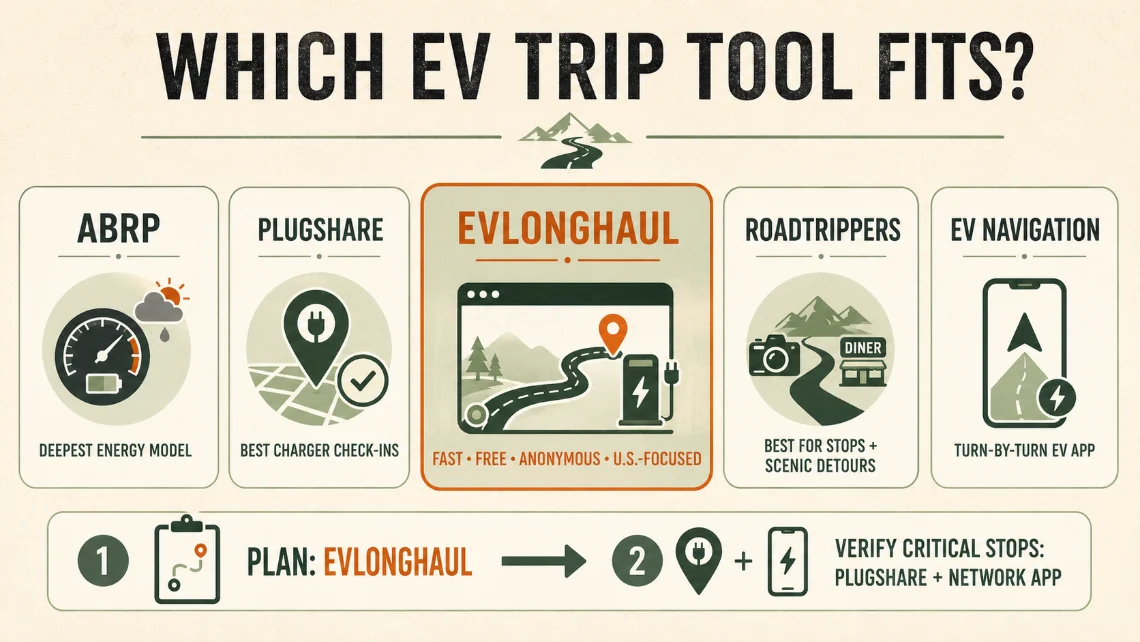
- You want maximum modeling precision and drive an EV like a flight sim: ABRP, probably with Premium.
- You want to know whether one specific charger works today: PlugShare's reviews, whatever else you use.
- You care most about what's worth stopping for between charges: Roadtrippers, alongside a real charging planner.
- You want a trustworthy U.S. road-trip plan in under a minute, free, with no account, that respects which networks you'll actually stop at: that is exactly what EVLONGHAUL is for.
- Belt and suspenders: plan with EVLONGHAUL, then spot-check your critical rural stops on PlugShare. The tools complement each other.