
Winter Range Loss: Planning EV Trips in the Cold
Last updated: July 23, 2026
Cold weather is the single biggest variable in EV trip planning. The car that comfortably makes a 180-mile leg in June can come up short on the identical leg in January, and the shortfall is physics, not a defect. This guide covers why cold cuts range, how large the loss usually is, and, concretely, how to build a winter margin into an EVLONGHAUL plan, because the planner does not do it for you.
Why cold cuts EV range
Three separate effects stack in winter, which is why the loss can feel larger than any one of them suggests.
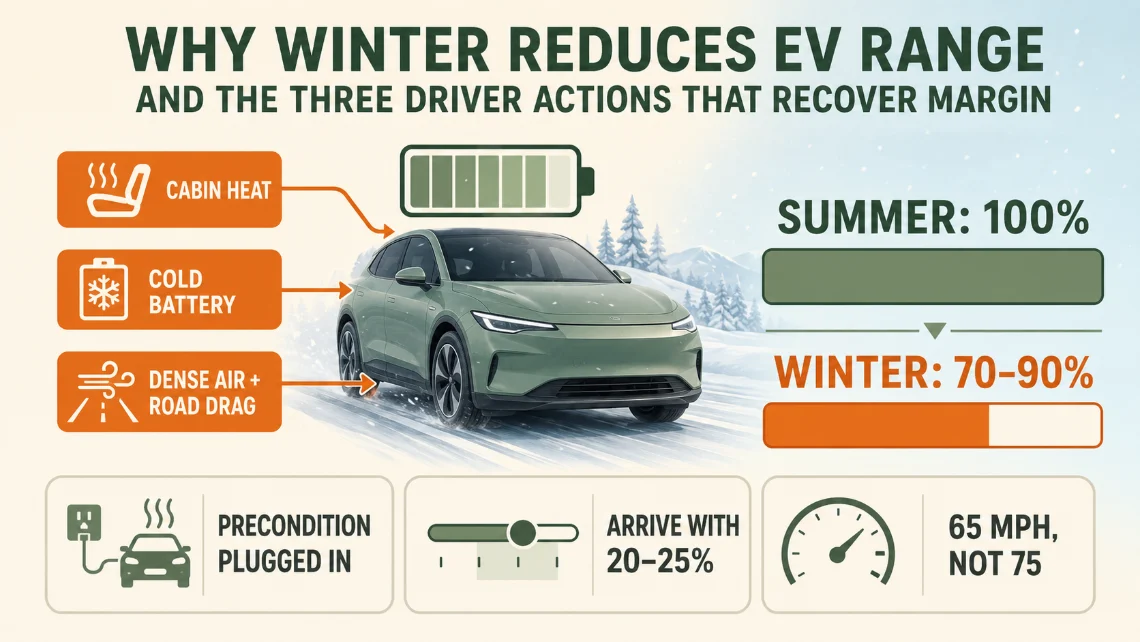
- Cabin heat comes out of the battery. A gas car heats its cabin with waste engine heat. An EV has to generate that heat, and a resistance heater can draw several kilowatts continuously: a meaningful fraction of what the motor itself uses at a steady cruise. Heat pumps move heat instead of making it, which cuts that draw substantially; cars equipped with them consistently hold up better in cold-weather fleet data.
- Battery chemistry slows down. Lithium-ion cells rely on chemical reactions that turn sluggish in the cold. Internal resistance rises, effective capacity dips, and most cars limit regenerative braking until the pack warms, so energy you would normally recover at stops and on descents is thrown away as friction-brake heat.
- Cold air is dense air. Aerodynamic drag scales with air density, and freezing air is noticeably denser than summer air. Winter tires, slush, and snow-covered pavement raise rolling resistance on top of that.
How much range you actually lose
Real-world winter losses commonly land in the 10–30 percent band. Fleet data from about 30,000 U.S. EVs, updated for the 2025–26 winter, puts the average at roughly a fifth of range gone at 32°F; heat-pump-equipped models hold on to roughly 8–10 percentage points more than resistance-heated ones, which trend toward a 25 percent loss. In genuinely extreme cold (near or below 0°F), losses can exceed 30 percent, especially in the first miles before the pack warms. The U.S. Department of Energy's fueleconomy.gov cold-weather page explains the mechanics in more detail.
Trip pattern matters as much as temperature. Short hops are the worst case: the cabin has to be reheated from cold every time, and the battery never reaches an efficient temperature. A long highway leg is comparatively kind: after the first half hour, the pack is warm and the heater is maintaining temperature rather than fighting for it. On a road trip you will usually see better efficiency on leg two than on leg one.
Highway speed makes it worse
Drag grows with the square of speed, and dense winter air multiplies the whole curve. The same 75 mph cruise that trims your range a little in July trims it more in January, and it compounds with the heater load. Two practical consequences:
- Slowing from 75 to 65 mph recovers a larger share of range in winter than in summer. On a leg that looks marginal, it is your cheapest insurance.
- Range estimates based on mixed or city driving flatter you. Judge a winter highway leg by what your car actually returns at your cruising speed with the heat on. The trip meter after 50 cold highway miles is worth more than any rating.
Precondition before you drive, and before you fast charge
Preconditioning is the one winter habit that costs nothing and pays twice.
- Before departure: heat the cabin while the car is still plugged in. The energy comes from the wall instead of the pack, and you leave with full range instead of spending the first kilowatt-hours warming seats and glass.
- Before DC fast charging: a cold-soaked pack charges slowly. It may accept only a fraction of a station's rated power for the first 15–30 minutes, so a stop at 150 kW hardware can behave like a 50 kW stop. Most EVs will warm the battery automatically if you navigate to the charger in the car's own navigation system; some also offer a manual battery-preconditioning control. Use one or the other on every winter fast-charging stop.
EVLONGHAUL's charge-time estimates already assume averages well below peak power because fast charging tapers, but a cold pack can undershoot even those estimates. If you are new to DC fast charging, Charging Levels Explained covers what the kW numbers mean in practice.
Setting up EVLONGHAUL for a winter trip
The planner computes usable range as your EPA rating times 0.92, a flat 8 percent buffer for highway speeds and weather. That buffer is not a winter model; at 20°F it is plainly not enough. The planner has no weather or elevation data, so the margin has to come from you, through the controls:
- Raise the minimum-arrival slider. This is the reserve the plan protects at every stop. Moving it from the default 15 percent to 20–25 percent shortens each leg and absorbs a cold day's extra consumption. It is the single most effective winter adjustment.
- Lower the starting-charge setting if the car sleeps outside. A cold soak overnight costs a few percent outright, and the first cold leg is your least efficient. If the dash says 90 percent on a frigid morning, plan as if it were 80.
- Filter to 150 kW+ stations. Cold packs charge slowly, so headroom matters: 150 kW or 250 kW hardware still delivers reasonable power to a pack that is throttling itself, where a 50 kW unit becomes painfully slow. Higher-power sites often have more stalls as well, though that varies by network (useful when winter demand peaks).
Each stop the planner places is a real DC fast-charging station from the U.S. DOE/NREL station database within about five miles of your route, placed in a window from roughly 35 miles before to a few miles past the point where your energy budget runs out. How We Plan Charge Stops explains the full method, including what a grey "suggested charge area" marker means.
What the planner does not know
EVLONGHAUL produces estimates from public data. It does not model temperature, wind, snow, or elevation, and it has no live charger status: a station shown on your route may be busy, iced over, or out of service when you arrive. In winter that caveat has teeth: cold weather is exactly when chargers see peak demand and hardware failures. Before you rely on a stop, verify it in a charging network app, and keep a fallback station in mind for any leg without slack. Our EV road-trip checklist has a pre-departure routine that covers this.
Plan the winter version of your trip honestly (higher reserve, lower starting charge, faster stations), and the cold becomes a scheduling detail instead of a roadside problem.