
The EV Road-Trip Checklist
Last updated: July 23, 2026
Most EV road-trip problems are solved before the car leaves the driveway. A dead card reader, an adapter that never shipped, a station that closed last month: none of these are hard to handle if you found out on Tuesday instead of at mile 240. This checklist covers the week before, the night before, and the habits that keep the driving itself uneventful.
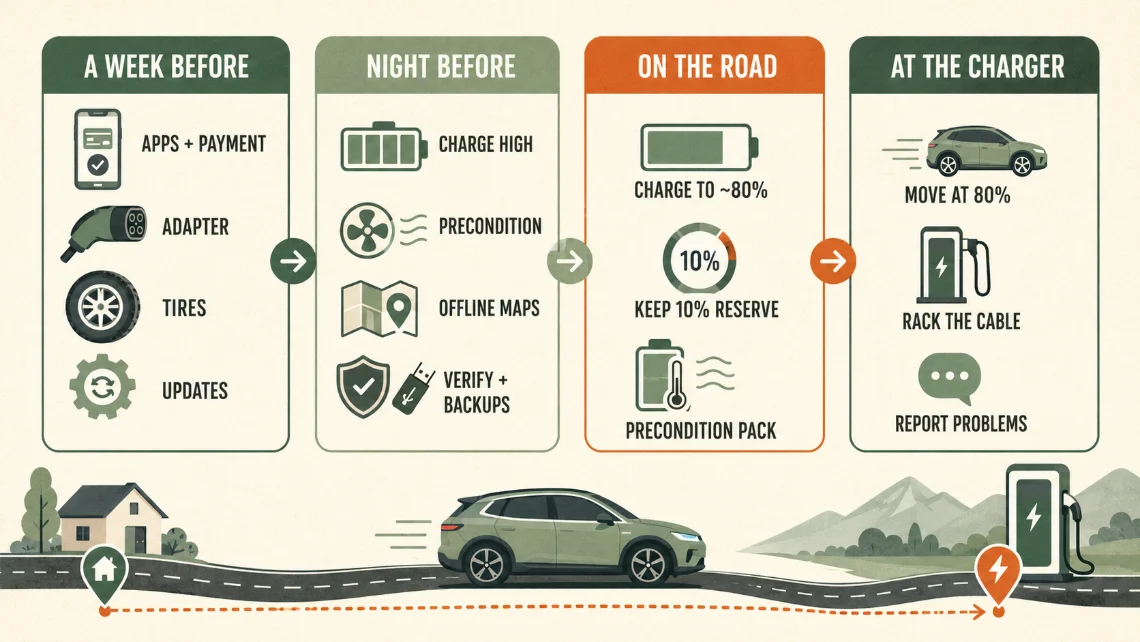
The week before: accounts and payment
Fast-charging networks work best when you already have an account, a saved payment method, and the app installed. Card readers at chargers are a common point of failure, and app-initiated sessions are usually the more reliable path.
- List the networks on your route. Plan the trip first, with EVLONGHAUL or however you like, and note which networks the stops belong to. Common ones on U.S. corridors include Tesla Supercharger, Electrify America, EVgo, and ChargePoint; IONNA is a newer network that is expanding quickly but still has far fewer sites.
- Create an account in each network's app and add a payment method now, while you have time to fix a declined card or a verification email that never arrives.
- Enroll in automatic payment where offered. Many networks and automaker apps now support plug-and-charge or one-tap sessions; setting it up at home is far easier than in a parking lot.
- Carry a physical credit card anyway. Apps need cell signal, and some rural stations sit in weak-coverage areas.
The week before: the car
- Order the adapter you need. Now. If your car has a CCS port and your route leans on Tesla Superchargers, you likely need an automaker-approved NACS adapter, ordered through your automaker's app or dealer. As of mid-2026 many automakers have adapters in stock, but availability varies by automaker and shipping still takes days. If you are not sure which port your car has, start with our CCS vs. NACS guide.
- Check the tires. Tread depth, pressure (set to the door-jamb spec), and no slow leaks. Many EVs ship without a spare, so pack a plug kit and a 12-volt inflator.
- Install pending software updates at home, on your own Wi-Fi. A one-hour update is a non-event in your garage and a real problem at a hotel the night before departure.
- Clear any service items. Low washer fluid, a worn wiper, an overdue tire rotation: small things become annoyances at highway pace.
The night before
- Charge to 90–100%. The everyday advice to stop at 80% is about long-term battery care during routine use; the night before a road trip is the exception. A full pack buys you a long first leg and more flexibility all day. Check your owner's manual if your automaker gives specific guidance.
- Set a departure or precondition schedule so the cabin and battery come up to temperature on wall power instead of spending range on it in the first ten miles.
- Download offline maps for your corridor in your navigation app of choice. Coverage gaps happen in exactly the places you least want to lose guidance.
- Check every planned station in its network's app. This is the step people skip. EVLONGHAUL places stops using public U.S. Department of Energy station data. It has no live status feed, so a station that looks fine in the plan could be busy, iced over, or down for maintenance. Open each stop in the network's own app, confirm it still exists, note the stall count and power level, and read any recent check-ins.
- Pick a backup for each stop. For every planned charger, find a second station within your remaining range. The DOE's Alternative Fuels Data Center station locator is a good place to browse what else is nearby.
- Stage the gear by the door: adapter, portable charge cord, tire kit, phone cables, and the physical wallet.
On the road: how much to charge
Road-trip charging rewards a specific rhythm, and it is not the one that feels intuitive at first.
- Charge to about 80%, not 100%. DC fast charging slows sharply as the pack fills; the last 20% can take as long as the middle 50%. Shorter, more frequent stops are almost always faster overall. This is why EVLONGHAUL's plan assumes you charge to 80% at every stop after the first leg. The reasoning is laid out in how we plan charge stops.
- Arrive with at least 10% in reserve. A buffer covers a full station, a detour, or a headwind. EVLONGHAUL already trims 8% off your EPA range before planning, but its numbers are estimates from public data. Treat the reserve as yours to protect, not the planner's.
- Precondition the battery before fast charging. Navigate to the charger in the car's own navigation system, or use the manual precondition option if your car has one. A pack at the right temperature can charge dramatically faster, especially in cold weather.
- Expect weather to matter. Heat, cold, rain, and headwinds all cut range, and the planner does not model them. In winter, plan shorter legs. Our winter range guide covers how much to expect to lose.
At the charger: etiquette
- Move your car when charging ends. At a busy site, unplug at 80% and free the stall; many networks charge idle fees for lingering (policies vary by network and station), and other drivers are waiting either way.
- Never unplug someone else's car while it is charging, even if the session looks finished. If a car is parked in a stall and not charging, a polite note or the station's app is the right channel.
- Rack the cable and connector properly. Connectors left on the ground get run over, and a damaged connector takes the stall out of service for everyone behind you.
- Report broken stalls in the network's app. It takes a minute and it is how the next driver (and eventually the public data EVLONGHAUL relies on) finds out.
The short version
- A week out: accounts, payment, adapter ordered, tires, software updates.
- The night before: charge high, schedule preconditioning, download offline maps, verify each station in its app, pick backups.
- On the road: charge to ~80%, keep a 10% reserve, precondition before fast charging, be a good neighbor at the stall.
The plan gets you a realistic set of stops; the checklist makes sure reality cooperates. Verify anything you are counting on before you drive.